
Delivery process · BBI Digital Studio
How a project runs from brief to launch
This page explains what working with BBI Digital Studio looks like in practice: the stages, who does what, and where your input is needed. It is written so you can plan your own time around the project, not just ours.
The six stages of an engagement
Every project moves through the same spine, though the weight of each stage shifts with the product. Below is the working order, what you get at the end of each stage, and where we need a decision from you.
Stage 01
Discovery and scoping
The cheapest place to fix a bad requirement
Every project starts with a discovery phase. We ask what the product must do, who uses it, what systems it touches, and what deadline is real. You get a scope document with phases and deliverables, plus a list of the assumptions we are making. If something in your requirements is unclear, this is the cheapest place to resolve it — a week of questions here saves a rebuild later.
Discovery is short by design. For a marketing site it can be a handful of conversations; for a platform with existing systems it takes longer, because we need to map what already exists before proposing anything. We come out of it with a written scope you can share internally, and with the risks named rather than discovered halfway through engineering.
We ask
What the product must do, who uses it, which systems it touches, and which deadline is real rather than aspirational.
You get
A scope document with phases, deliverables, and the assumptions we are working from, written so you can circulate it.
You decide
Which features matter for the first usable version, and which ones can wait for a later phase.
Design and prototyping · working session
Stage 02
Design and prototyping
You review behaviour, not pictures
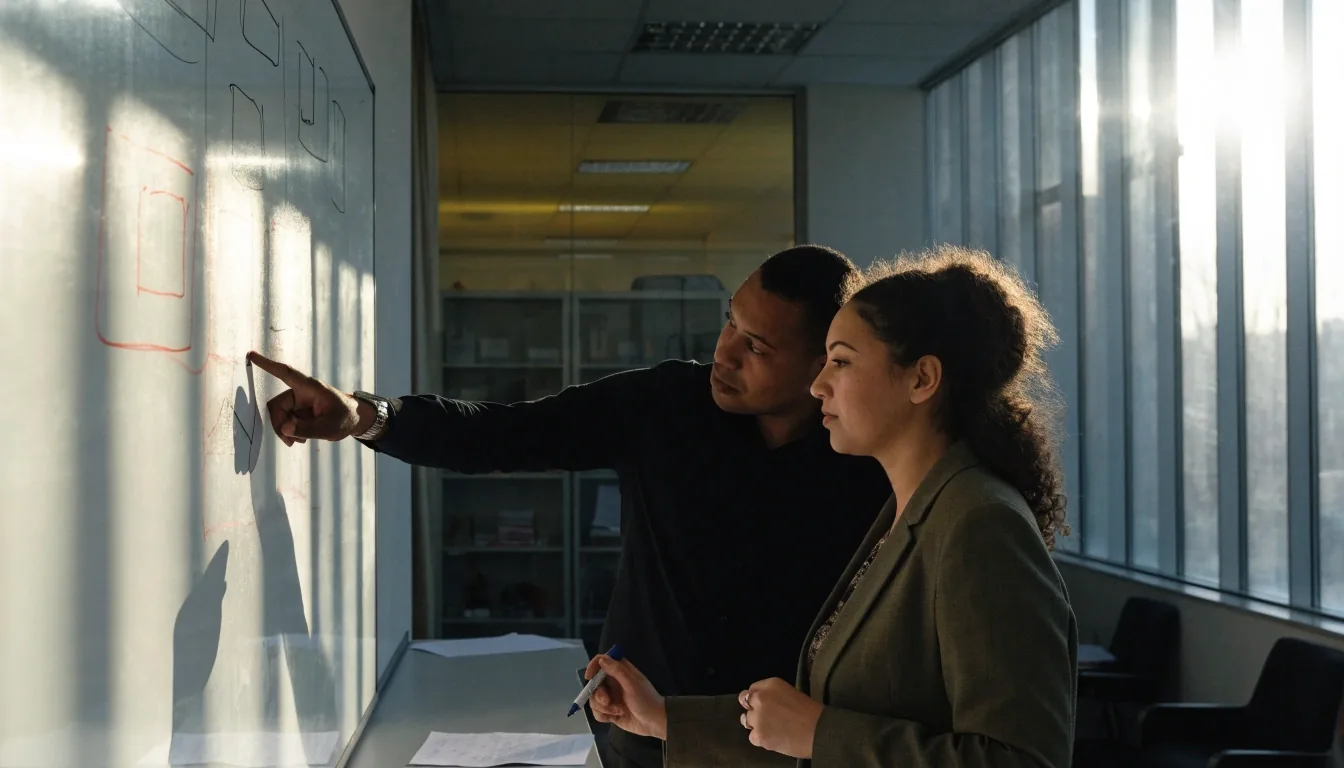
Design moves from structure to interface. We map the main user flows first, then build screens for the tasks that matter most — signup, checkout, or a core internal action your team repeats daily. You review working prototypes rather than static pictures where possible, because behaviour is easier to judge than a mockup. Feedback rounds are scheduled, not open-ended.
What we bring
User flows, then interface screens for the highest-value tasks. Prototypes you can click through on your own device, and a component set your engineers will actually build from.
What we need from you
A decision-maker in the review sessions, and feedback inside the scheduled window. Design stalls when comments arrive in fragments over two weeks instead of one sitting.
Stage 03 and 04 · engineering, then testing
Built in short cycles, tested before it ships
Engineering and environments
Development runs in short cycles with a staging environment you can open at any time. That means you see progress between milestones instead of waiting for a big reveal. Backend, front end, and integrations are built in the order that reduces risk, so the uncertain parts get tested early rather than in the final week.
Code sits in a repository you have access to from day one. Environments are named and separate — nothing is developed directly against production.
QA and testing
Testing covers function, performance, and the devices your users actually carry. For mobile work that includes mid-range Android hardware common in Kazakhstan, not only flagship phones. For web projects we check load behaviour under realistic traffic and verify integrations against test data before anything touches production.
Anything found is logged with steps to reproduce, fixed, and re-tested on the same device before the release moves forward.
What each cycle produces
Working software
A build you can open on staging, not a status report about one.
Test notes
What was checked, on which devices, and what was found and resolved.
Next decisions
The questions we need answered before the following cycle starts.
Stages 05 and 06
Launch, then support
A launch checklist, and the months after it
Launch is planned as a checklist: data migration, DNS, monitoring, backups, and a rollback path if something goes wrong. We schedule it for a window that suits your business, not ours. After go-live we watch the first days closely and fix issues as they appear.
Before go-live
Migration rehearsed on a copy of the data, DNS changes prepared in advance, monitoring and backups switched on before the switch, and a rollback path written down and tested.
During launch
A quiet window agreed with you, someone on call while it happens, and a short list of what to watch in the first hours. You get told what is happening rather than asking.
After go-live
Work continues in whatever shape fits: a monthly support arrangement, a backlog of improvements, or a next phase. We document the system so your team is not dependent on one person's memory, and handover includes access, credentials, and a walkthrough.
Your side of the project
What we need from you
A decision-maker who can approve scope and design, access to any existing systems, and timely feedback at review points. Projects slow down most often when approvals wait. We will tell you clearly when we are blocked, and what it costs in schedule.
- One named decision-maker for scope and design approvals.
- Access to existing systems, accounts, or data we have to work with.
- Feedback inside the scheduled review window, not in fragments afterwards.
- A single point of contact on our side coordinates design, engineering, and QA for you.
Timelines, honestly
What fits, and when
A marketing site can go live in a few weeks. A custom platform or app usually runs in stages over a longer period, and the first usable version arrives before the last feature.
We do not promise dates we cannot hold. If a deadline is fixed, we say what can realistically fit inside it and what has to move to a later phase — before the work starts, not after.
Request a scoped estimate →Common questions
If your question is not here, write to us and we will answer it plainly before you commit to anything.
Talk to the studioHow long does a project take?
It depends on scope. Simple sites move in weeks; custom software and apps are delivered in phases over a longer timeline. Discovery gives you a realistic range before you commit to a build.
Who is my main contact?
You get a single point of contact for the project who coordinates design, engineering, and QA. You are not passed between departments to get an answer.
What if our requirements change mid-project?
Changes are handled as scope adjustments with a clear effect on timeline and cost, agreed before work continues. Nothing is added silently, and nothing is removed without telling you.
Do you work with fixed-price contracts?
Where scope is clear, yes. For evolving products we often work in phases so each stage is priced with more certainty as the requirements settle.
Start with a scope, not a signature
Tell us what the product has to do and who it serves. Discovery is the smallest useful commitment we can make to each other, and it ends with a written scope you can take anywhere.
Studio contact
-
Email
kanogml1201@gmail.com -
Phone
+1 (815) 934-4003 -
Almaty office
Furmanov Ave 110, 050000 Almaty, Kazakhstan
-
Working hours
Monday to Friday, 9:00 AM – 6:00 PM